
Date: October 20, 2026 | 1:00 PM EST / 12:00 PM CST
Duration: 1 Hour
Credits: 1
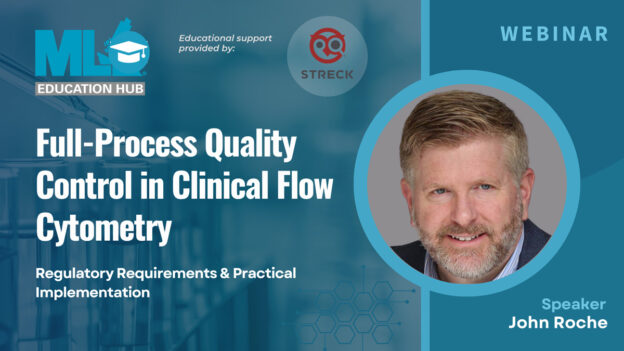
Presenter: John Roche, B.S., M.S.
Sponsor: Streck
Cost: Free
Quality control is performed daily in every clinical flow cytometry laboratory, yet routine instrument and reagent checks may not address the pre-analytic and analytic variables that influence patient results. Regulatory expectations for monitoring the complete analytic process are frequently misunderstood.
This continuing education webinar reviews the regulatory and consensus-standard framework governing full-process quality control in United States clinical flow cytometry laboratories. The session outlines the relationship between CMS oversight, CLIA regulations (42 CFR Part 493), and CAP accreditation. It then examines the CLIA requirement to monitor “the accuracy and precision of the complete analytic process,” the corresponding CAP Flow Cytometry Checklist items evaluated during inspection, and how CLSI H62 translates these requirements into documented laboratory practice. Common gaps between routine QC activity and full-process monitoring are described. Regulatory citations are provided throughout so participants can review primary source language directly.
Learning Objectives
At the conclusion of this webinar, participants will be able to:
- Describe the respective roles of CMS, CLIA, FDA, and CAP accreditation in establishing quality control requirements for US clinical flow cytometry laboratories.
- Differentiate full-process quality control from instrument-only analytical QC and from laboratory-developed test (LDT) validation in terms of which steps of the testing workflow each does and does not challenge.
- Explain the CLIA requirement at 42 CFR 493.1256 to monitor “the accuracy and precision of the complete analytic process,” including the individualized quality control plan (IQCP) alternative.
- Identify the CAP Flow Cytometry Checklist requirements for daily full-process controls in qualitative and quantitative assays, and how CLSI H62 guidance addresses them.
- Compare the strengths and limitations of patient-sample, in-house cell-line, and commercially available assayed process controls relative to the requirements discussed.
About the Presenter

John Roche is a biomedical engineer and regulatory affairs expert who has spent decades developing hematology and flow cytometry instruments used by laboratories today. As an engineering and regulatory affairs leader in the IVD industry, he holds seventeen U.S. patents and contributed to twenty FDA clearances in the fields of flow cytometry and hematology. Mr. Roche has also been involved in establishing CLIA laboratories and working to put in place lab developed tests (LDTs) at these facilities. He holds a B.S. in Biomedical Engineering from Rensselaer Polytechnic Institute and an M.S. in Electrical/Computer Engineering from Manhattan University.
Supported in part through an unrestricted educational grant by:

Course Includes
- 1 Lesson
- Course Certificate

Medical Laboratory Observer (MLO) is approved as a provider of continuing education programs in the clinical laboratory sciences by the ASCLS P.A.C.E. ® Program.
Level of Instruction: Intermediate
Passing scores of 70 percent or higher are eligible for 1 contact hour of P.A.C.E. credit. This test is no longer valid for CEs after October 19, 2027.