
Date: November 18, 2026 | 12:00 PM EST / 11:00 AM CST
Duration: 1 Hour
Credits: 1
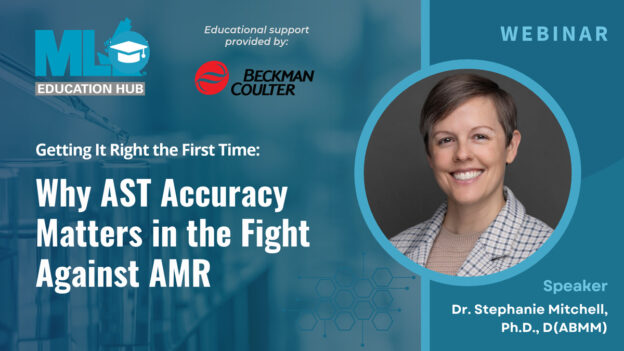
Presenter: Dr. Stephanie Mitchell, Ph.D., D(ABMM)
Sponsor: Beckman Coulter
Cost: Free
Antimicrobial resistance (AMR) continues to challenge healthcare systems worldwide, making timely and accurate antibiotic therapy decisions more important than ever. As resistant pathogens become increasingly prevalent and new mechanisms of resistance emerge, clinical laboratories play a critical role in supporting antimicrobial stewardship through accurate antimicrobial susceptibility testing (AST).
This webinar will explore the relationship between resistance detection, susceptibility testing accuracy, and patient treatment decisions. Using a clinical case involving a carbapenem-resistant Klebsiella pneumoniae urinary tract infection, attendees will follow the diagnostic journey from organism identification through resistance detection and definitive therapy selection. The session will highlight how microbiology results inform treatment decisions and why both phenotypic and genotypic information are increasingly important in today’s AMR landscape.
Participants will gain insight into:
- Current trends driving the global antimicrobial resistance crisis
- The growing importance of identifying specific resistance mechanisms
- How phenotypic AST and genetic resistance markers work together to guide therapy
- The clinical impact of inaccurate or delayed susceptibility results
- Factors influencing AST performance, including breakpoints, epidemiology, and testing methodology
- Practical considerations for evaluating AST systems and supporting antimicrobial stewardship initiatives
The webinar will also review evidence regarding AST performance and discuss the consequences of false-susceptible results, delayed reporting, and testing limitations on patient outcomes. Attendees will leave with a better understanding of how accurate resistance detection supports more confident treatment decisions, improved laboratory efficiency, and better patient care.
This session is intended for microbiology laboratory professionals, laboratory directors, infectious disease specialists, pharmacists, antimicrobial stewardship teams, and other healthcare professionals involved in diagnostic and treatment decision-making.
Register today to learn how accurate resistance detection can help support the right therapy, the first time.
Learning Objectives
At the conclusion of this webinar, participants will be able to:
- Describe how phenotypic AST results and genetic resistance markers contribute to antimicrobial therapy decisions.
- Explain the relationship between antimicrobial resistance mechanisms and emerging mechanism-specific treatment options.
- Evaluate factors that influence AST performance, including testing methodology, breakpoints, resistance mechanisms, and epidemiology.
About the Presenter

Dr. Stephanie Mitchell, Ph.D., D(ABMM) serves as the Senior Director, Medical and Scientific Affairs – Infectious Diseases and Microbiology at Beckman Coulter. She received her Ph.D. in Molecular Microbiology from Tufts University. After completing her Medical and Public Health Microbiology CPEP Fellowship at the University of Pennsylvania and receiving board certification in Medical Microbiology, she served as the Medical Director of two full-service clinical microbiology laboratories at a large tertiary academic medical center and held dual appointments as Assistant Professor at the University of Pittsburgh School and Medicine and the University of Pittsburgh School of Public Health. Dr. Mitchell currently volunteers for several professional societies, such as the American Society of Microbiology and the Clinical Laboratory and Standards Institute (CLSI) Antimicrobial Susceptibility Testing Committee, CLSI Antifungal Susceptibility Testing Committee and CLSI Expert Panel for Microbiology.
Supported in part through an unrestricted educational grant by:

Course Includes
- 1 Lesson
- Course Certificate

Medical Laboratory Observer (MLO) is approved as a provider of continuing education programs in the clinical laboratory sciences by the ASCLS P.A.C.E. ® Program.
Level of Instruction: Intermediate
Passing scores of 70 percent or higher are eligible for 1 contact hour of P.A.C.E. credit. This test is no longer valid for CEs after November 17, 2027.